
AI Detector A Practical Guide to Understanding AI-Generated Content
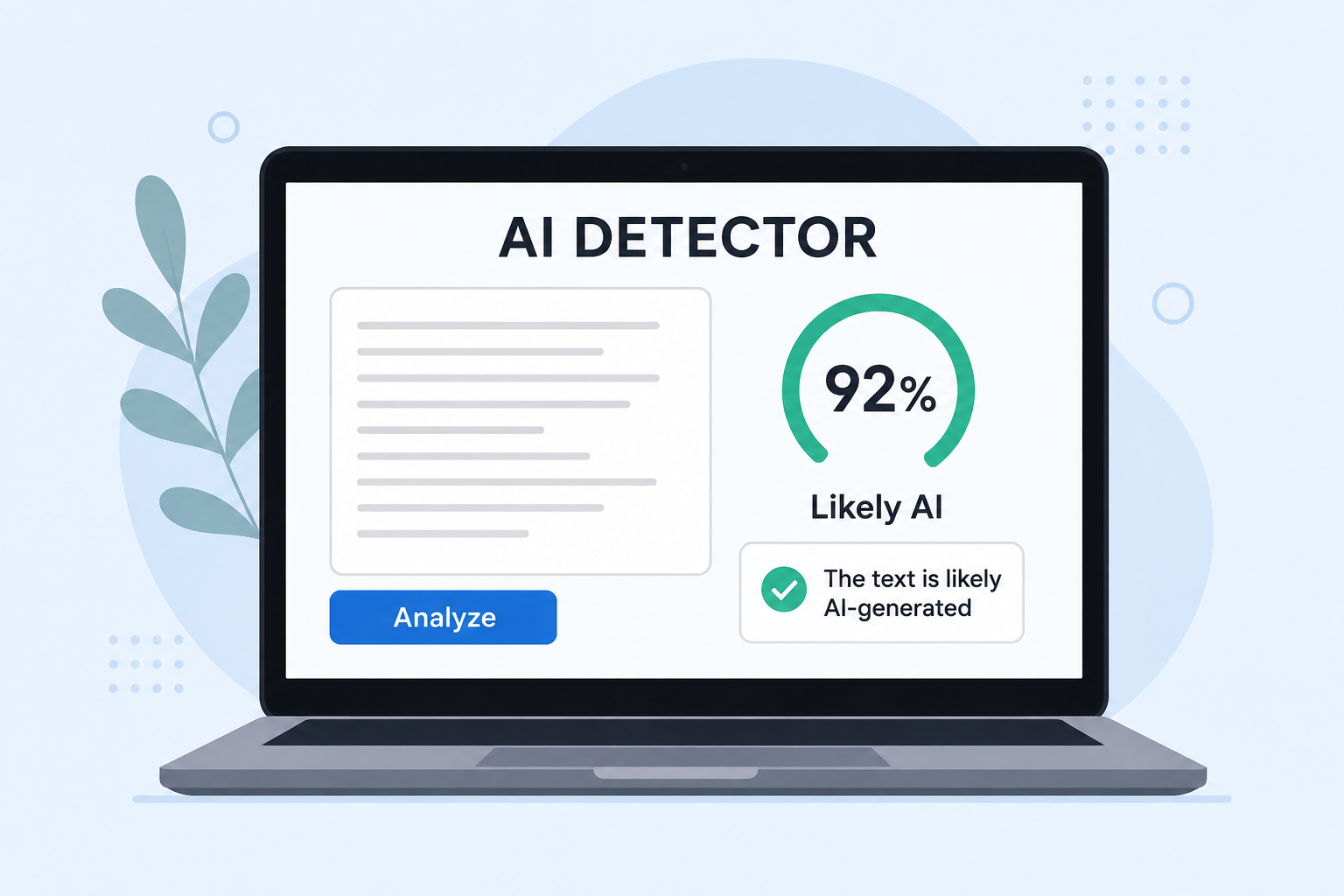
AI tools have become a standard part of a student’s writing process, as well as a business’s email drafting and content-readiness tools, and everyone’s creative idea generation tool, making it more important than ever to see how a document may have involved AI in its construction. With AI tools and software, users can identify if written content may have been created using artificial intelligence.
While it is important to identify when AI tools are being used, we also need to develop a more sophisticated way to evaluate the results of these tools and understand the context of when they may be helpful.
What Is an AI Detector?
An AI detector is a computer program that evaluates text for characteristics associated with text generated by artificial intelligence. Some track sentence structure, choice of words, pattern prediction, repetition, and placement of ideas.
While the advanced nature of generative AI such as ChatGPT, Google Gemini, and Claude, makes it much easier for people to create text that looks natural, that text can still look human-generated. Because of the advanced systems AI can employ, standard proofreading may no longer expose how text was generated. When in doubt about how a document was generated, an AI detector can look for patterns and text characteristics and provide supplemental analysis.
How AI Detection Works
AI detection systems use natural language processing and text analysis to compute the likely digital contribution to the construction of the text.
Predictability in output is one issue. AI language models draft choices based on word probabilities derived from training data. Despite the randomness of the training data model, predictable phrasing can still occur. Variation in output is another issue. Human writers vary their phrasing, vocabulary, sentence length, and cadence. Content generated by AI can lack some of these patterns.
Depending on the system, an AI detector looks at:
Sentence structure
Word choice
Predictable language
Vocabulary
Language consistency
Patterns in phrasing and repetition
Because different detectors use different methods, there isn't always consistency in the results.
Understanding False Positives
False positives are when a system intended to check for artificial intelligence-related writing actually does the opposite. Basically, mistaking legitimate human-written text for computer-generated text.
There are multiple reasons as to why this happens. Sometimes, formal writing, writing with repetitive structures or passages, heavily edited writing, short text, or writing with particular styles can cause false positives.
False positives usually happen because when machine learning text is checked, there are certain factors that cannot be described but are (understandably) checked. These factors, however, do not mean that the writing checked was not original. Heavily communicated writing (like research) can have strong evidence that the writing was written and checked by a real person.
Why Human Review Still Matters
Automated systems cannot determine every element of a work that was written in a human language, meaning that an automated system cannot read every work written by a human. Because of this, human judgment is necessary to interpret the results.
The proper order to check for these substantive elements of a work would be to use an AI detection system and then do a fact check, originality check, edit the work, verify sources, and perform a contextual review, as opposed to relying on a single numerical score.
Using an AI Detector With isgen.ai
Isgen has created a set of tools that can assist its users in their work. AI-related technology can benefit multiple sectors of society including, publishers, businesses, educators, and students as well as marketers and writers. An AI detector can help all of these groups see the potential of AI technology.
Treating detection as part of a complete content quality analysis offers the most practically useful approach. Users should strive to develop informative and accurate text, that is not copied or plagiarized, and is original, naturally flowing, and beneficial to the reader.
Best AI Detection Practices
For truly beneficial outcomes, users should implement some straightforward practices.
Text Length Matters
Very short texts provide few linguistic signals, making significant results less probable. As a result, longer passages are preferable.
Contextual Clues Help
The result of a detection should be considered along with the context of the content and the available evidences.
Don’t Assign Too Much Value to Scores
AI probability scores should not be seen as true, inherent outcomes. They are only estimates that reflect existing patterns.
Multiple Checks Matter
AI detection should be complemented by various other checks on writing quality such as plagiarism checks, proofreading, fact checks, citation reviews, and editing by humans.
Conclusion
As AI technologies begin to transform how we create and consume written content, AI writing detectors become increasingly important. AI detectors analyze linguistic and statistical patterns, making it possible to understand text that has been generated using AI technology.
As long as the limitations of these technologies are recognized, using an AI detector is useful. They should not be used to substitute for good judgment, nor should detection scores be considered completely conclusive. AI detection, along with an originality checker and a fact checker, is a useful addition to content analysis.
Given how quickly ChatGPT and other similar AI tools are advancing, isgen.ai's products can help people feel more confident and aware when confronting the new and rapidly shifting relationship between human writing and AI.

 English
 Arabic
 French
 Spanish
 Portuguese
 Deutsch
 Turkish
 Italiano
 Russian
 Romaian
 Portuguese (Brazil)
 Greek
Greek