
IELTS Coaching in Jaipur for UK University Aspirants: How to Prepare Before Your Application
Let me start with something I see every week. A student walks in, bright-eyed and ambitious. They've got good marks. They've got a clear career goal. They've even shortlisted their UK universities. Then I ask about IELTS. They shrug. "I'll take it next month," they say. "My English is fine."
Three months later, they're still stuck. Their scores aren't improving. They've missed application deadlines. And the January intake they were targeting has already closed.
The problem isn't their English. The problem is they treated IELTS like an afterthought. Let me explain why that's a mistake and how you should actually prepare.
Why IELTS Matters More Than You Think
Here's the thing about IELTS. UK universities don't just want to know that you speak English. They want to know that you can handle academic work in English. There's a big difference.
Your score determines your eligibility. Most UK universities ask for 6.5 overall with no band less than 6.0. Competitive programmes ask for 7.0 or higher. That's the minimum. You need to meet it to even be considered.
But here's what most students don't realise. A higher score makes you more competitive. If two students have similar academic records, the one with the better IELTS score gets the offer. It's that simple.
The Jaipur Coaching Landscape
Jaipur has no shortage of coaching centres. Walk down any main road and you'll see banners promising guaranteed scores, crash courses, and overnight success. Most of them are selling dreams, not results.
What distinguishes a good IELTS Coaching Institute in Jaipur from the mediocre one is the approach. Good coaching doesn't just teach you English. It teaches you the test.
IELTS is formulaic. The same question types appear again and again. The marking criteria are consistent. Once you understand the patterns, you can prepare strategically. This is what good coaching should provide.
The students who succeed are the ones who treat IELTS as a skill to be learned, not knowledge to be tested. You can be fluent in English and still score poorly if you don't understand what the examiners are looking for.
What Beginners Get Wrong
The most common mistake is starting too late. Students book the test, then start preparing two weeks before. They take a few practice tests, learn a few essay templates, and hope for the best. It rarely works.
IELTS requires consistent effort over time. Your listening improves with daily practice. Your writing improves with regular feedback. Your speaking improves with actual conversation. Two weeks isn't enough.
Another mistake is focusing on the wrong areas. Students spend hours memorising vocabulary lists when they should be practising task completion. They practice reading comprehension but ignore time management. The test is as much about strategy as it is about language.
The third mistake is avoiding feedback. Students write essays but never get them marked. They speak but never record themselves. They don't know what they're doing wrong because no one tells them. This is where coaching adds value.
What Good Coaching Actually Looks Like
A decent coaching programme starts with assessment. You take a full practice test under exam conditions. Your scores show your baseline. This tells you where to focus your efforts.
The teaching should be skill-specific. Reading, writing, speaking, and listening all require different approaches. General English lessons won't help. You need test-specific strategies.
For writing, you need task achievement and coherence. You need to understand what examiners want in task response, how to structure arguments, and when to use complex sentences naturally. You need someone who marks your essays properly, not just checks grammar.
For speaking, you need fluency and pronunciation. You need to practice answering questions under pressure. You need to expand your answers beyond simple statements. Record yourself. Listen back. Notice where you hesitate or repeat yourself. Work on those specific gaps.
For listening, you need to practice with the right speed. The IELTS listening test includes different accents—British, Australian, American. You need exposure to all of them.
For reading, you need scanning and skimming skills. You need to find information quickly without reading every word. You need to manage time across three passages.
When to Start Preparing
This is the part that frustrates students. They think they can prepare in a month. The reality is different.
If you're starting from a band score of 5.5 and need 6.5, you're looking at eight to twelve weeks of focused study. That's with good coaching and consistent practice. If you need 7.0, give yourself three to four months.
The students who succeed are the ones who treat IELTS preparation seriously from the start. They don't leave it to the last minute. They build it into their study abroad timeline.
A good consultant helps you plan this timeline backwards from your target intake. If you want to start in January, you need your IELTS score by October. That means starting preparation in July or August.
The Coaching and Consultant Connection
This is where the best study abroad consultants in Jaipur actually earn their value. Good consultants don't just handle applications. They understand the entire pipeline, including the language requirements.
A consultant can tell you which IELTS score each university expects. They can suggest how much time you need to prepare. They can recommend coaching centres that consistently produce results. If you're in Jaipur, they know which local centres have good track records.
They also understand the timing. You can't take IELTS in November and expect to start in January. The score needs to reach the university, the CAS needs to be issued, and the visa needs to be processed. All of this takes time. Consultants help you plan backwards.
The IELTS Journey: From Beginner to Test Day
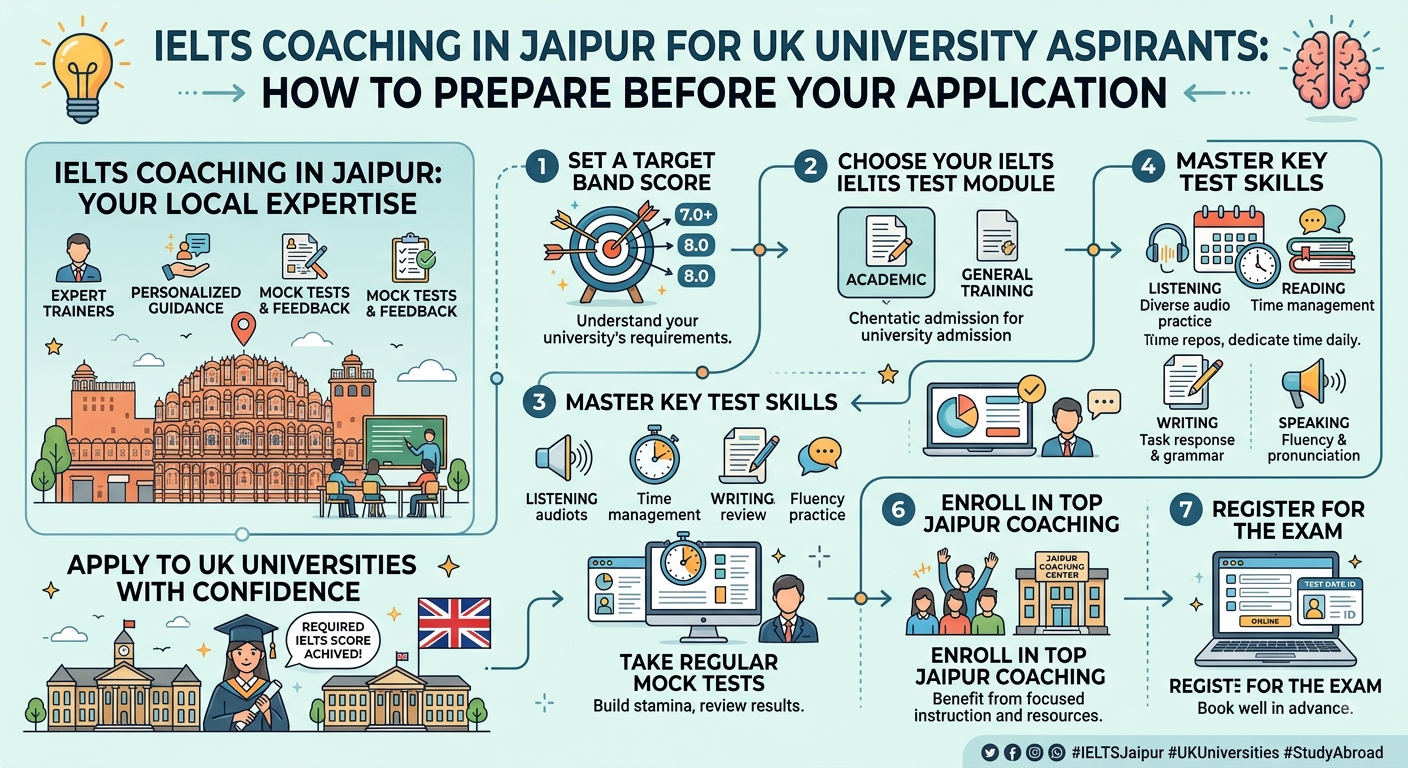
Start with a diagnostic test. This tells you where you actually stand. You might think you're weak in writing but actually your listening is worse. Let the data guide your preparation.
Build a study schedule. Two hours a day, six days a week is realistic for most students. Include practice tests, skill-building exercises, and vocabulary work. Consistency beats intensity.
Take at least one full practice test every week. The IELTS test is four hours long. You need stamina. Practice under exam conditions, with timing and no interruptions.
Mark your own work or get it marked. The test is online, so practice typing your essays if you're taking the computer-based test. If you're taking paper-based, practice handwriting clearly.
In the final weeks, focus on weak areas. Don't waste time on skills you've already mastered. Polish your essay structures. Practice your speaking responses until they feel natural.
What Happens After the Test
You get your results in three to thirteen days depending on the test format. If you meet your target, great. If not, you need to decide whether to retake.
Some students retake individual sections if their overall score is good but one skill is low. Others retake the entire test. The strategy depends on your specific situation and deadlines.
Whatever you do, don't cancel your application plans. A lower score doesn't mean you can't study in the UK. Some universities offer pre-sessional English courses that accept lower IELTS scores. This adds time and cost but keeps your options open.
The Bottom Line
IELTS is a hurdle, not a barrier. Thousands of Indian students clear it every year. You can too. The question is whether you prepare properly or scramble at the last minute.
Good coaching in Jaipur gives you structure, feedback, and accountability. It stops you from wasting time on ineffective strategies. It pushes you to practice consistently. And it shows you exactly what the examiners want.
The students who treat IELTS preparation seriously are the ones who score well. The ones who assume it's easy are the ones who retake the test multiple times. The choice is yours.
If you're in Jaipur, you have options. Look for coaching that offers proper assessment, skill-specific teaching, and regular feedback. Ask about their track record. Talk to past students. Make an informed choice.
And if you're unsure, talk to a consultant who understands the whole process. They'll help you plan your timeline, choose the right coaching, and connect your IELTS preparation to your overall study abroad goals.

 English
 Arabic
 French
 Spanish
 Portuguese
 Deutsch
 Turkish
 Dutch
Dutch
 Russian
 Romaian
 Portuguese (Brazil)
 Greek
Greek