
Why Premium Solar Installation Matters for Long-Term Solar Performance?
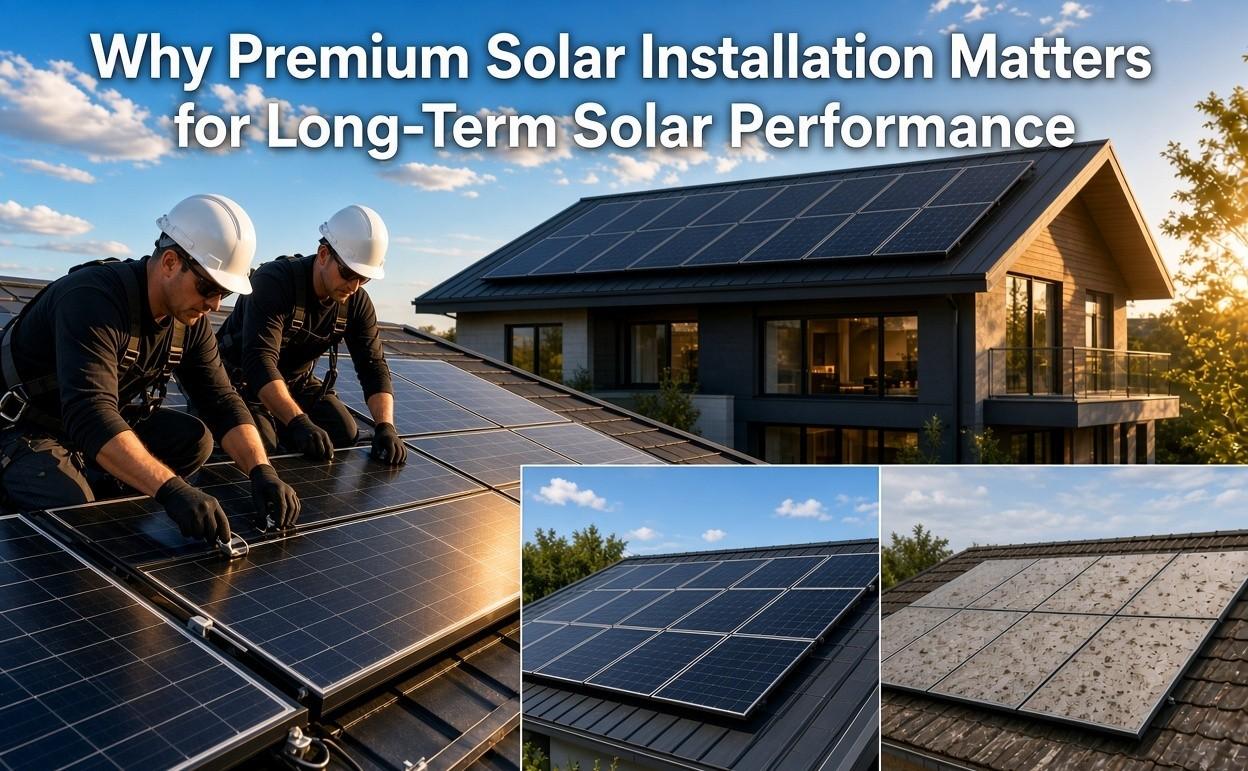
Choosing solar panels is often the most visible part of going solar. Homeowners and businesses compare panel efficiency, inverter brands, system size and price—but there is another decision that can have just as much impact on the result: who installs the system and how well the installation is carried out.
A solar system is a long-term investment. A high-quality panel cannot compensate for poor system design, incorrect mounting, inadequate electrical connections, shading that was overlooked during planning, or insufficient after-sales support.
This is why premium solar installation should not simply mean paying more. It should mean paying for better planning, workmanship, component selection, safety, documentation and long-term system support.
Solar adoption is also expanding rapidly. The International Energy Agency reported that global solar PV additions exceeded 600 GW in 2025, while India added almost 50 GW of solar PV during the year. As more consumers enter the market, understanding installation quality becomes increasingly important.
What Is Premium Solar Installation?
Premium solar installation is a quality-focused approach to designing and installing a solar energy system.
It generally involves:
- Assessing the property before recommending system size
- Evaluating roof condition, orientation and available space
- Considering shading throughout the day
- Selecting suitable panels, inverters and other components
- Designing safe and organized electrical connections
- Using appropriate mounting structures and installation methods
- Testing the completed system
- Providing documentation and ongoing support
The key difference is that the focus isn't simply on getting panels onto a roof. The objective is to create a system that performs reliably and safely over many years.
For Indian homeowners, this also matters when government incentives or rooftop-solar programmes are involved. The Ministry of New and Renewable Energy (MNRE) states that residential rooftop systems under its programme involve installation by empanelled vendors and verification by the relevant DISCOM for applicable central financial assistance.
1. Better Installation Can Protect Your Long-Term Investment
Solar panels are designed to operate for decades, but their performance naturally changes over time.
NREL research shows that PV modules commonly experience gradual degradation, with typical rates often around 0.5%–1% per year, depending on technology and conditions.
That natural degradation is expected. Problems caused by poor installation are different.
For example, imagine two homes installing similar solar panels. One system is carefully designed, correctly mounted, properly wired and monitored. The other is installed primarily to minimize upfront cost.
Both systems may look similar immediately after installation. But if the second system develops avoidable issues—such as poor cable management, water ingress, unsuitable mounting or recurring electrical faults—the owner may face additional repair costs and lost generation.
Premium installation is therefore about controlling avoidable risks before they become expensive problems.
2. System Design Matters as Much as Equipment
A common misconception is that buying high-efficiency panels automatically guarantees high solar production.
It doesn't.
Actual output depends on several factors, including location, roof orientation, tilt, shading, system configuration, inverter losses and downtime. NREL's residential PV analysis specifically notes that system performance varies significantly with location and system configuration.
A quality installer should therefore assess the property rather than simply recommend a standard package.
For example, a roof may have:
- Partial shade from trees
- Nearby buildings
- Multiple roof orientations
- Limited usable space
- Structural limitations
- Areas affected by future shading
Identifying these factors before installation can help prevent performance problems later.
3. Proper Mounting Protects the Roof and Solar System
Solar panels need a secure mounting system that is appropriate for the roof and local conditions.
Installation quality matters because the mounting structure must support the panels while dealing with environmental exposure such as wind, rain, heat and dust.
Poor workmanship can create unnecessary risks, including roof damage, loose components or difficult maintenance access.
A premium installation approach considers the roof and solar system together.
The installer should evaluate the roof's condition, select an appropriate mounting method and ensure that penetrations, waterproofing and cable routing are handled correctly where applicable.
This is particularly important because replacing a roof or repairing water damage can become significantly more expensive than doing the installation correctly in the first place.
4. Electrical Work Should Never Be an Afterthought
Solar systems generate electricity, so electrical installation is a critical safety consideration.
Quality installation includes properly planned wiring, suitable protection equipment, secure connections, grounding/earthing where required, and appropriate placement of electrical equipment.
Good cable management also matters. Cables should not simply be left exposed or loosely arranged across a roof.
A professional installation should leave the system organized, accessible for inspection and built around applicable electrical and safety requirements.
This is one area where choosing an installer based solely on the lowest quotation can create unnecessary risk.
5. Premium Installation Can Reduce Performance Losses
Solar production can be affected by factors beyond the rated efficiency of the panels.
NREL research identifies system-level factors such as inverter losses, downtime and degradation as contributors to actual PV performance.
Consider a simple example.
A homeowner purchases a 5 kW solar system expecting it to meaningfully reduce grid electricity consumption. If the system is poorly positioned, experiences avoidable downtime or has installation-related faults, its real-world production may fall short of expectations.
A professional installer should establish realistic expectations based on the property's conditions rather than promising a generic amount of savings.
The goal is not to promise maximum production on paper; it is to build a system capable of delivering dependable real-world performance.
6. Monitoring Helps Identify Problems Earlier
A good solar installation should not become invisible after commissioning.
Monitoring can help homeowners understand whether the system is producing as expected and identify unusual changes in performance.
For example, a sudden drop in generation could potentially indicate an equipment issue, shading change, connection problem or another condition that requires investigation.
Early identification can be valuable because a small issue may be easier and less expensive to address than a problem that remains unnoticed for months.
This is why after-sales service should be considered part of installation quality—not an optional extra.
A Realistic Example: Cheap Installation vs. Quality Installation
Consider two hypothetical 5 kW residential systems.
System A has a lower upfront price. The installer performs a basic site visit, uses a standard layout and completes the installation quickly.
System B costs more initially. The installer performs a detailed site assessment, checks shading and roof conditions, plans cable routes, selects appropriate equipment, documents the installation and provides monitoring and support.
System A may look more attractive on quotation day.
But if System B experiences fewer avoidable faults, produces closer to its expected output and is easier to maintain, its higher initial cost could make more sense over the system's lifetime.
This example is illustrative rather than a measured case study: the actual financial outcome depends on equipment, location, electricity tariffs, financing, maintenance and installation quality.
What Should You Ask a Solar Installer?
Before choosing a premium solar installation provider, ask:
- How will you assess my roof and shading?
- Why are you recommending this system size?
- Which panels, inverter and mounting components are included?
- How will electrical safety and cable management be handled?
- What testing is performed after installation?
- How can I monitor system performance?
- What warranties apply to equipment and workmanship?
- Who provides support if something goes wrong?
- Will you assist with applicable approvals and documentation?
- What assumptions were used for the expected savings?
These questions help shift the conversation away from "How cheap is the installation?" toward "What am I actually getting for my investment?"
Why This Matters for Solar Buyers in India
India's solar market is expanding quickly. The IEA reported that India's renewable capacity additions increased by almost 60% in 2025, driven in large part by nearly 50 GW of new solar PV capacity.
At the same time, government programmes are encouraging residential rooftop solar adoption. MNRE's rooftop solar programme provides information on central financial assistance, installation mechanisms and verification requirements.
For consumers, this creates opportunity—but also makes installer selection increasingly important.
A solar system is not just a collection of panels. It is a complete energy system whose design, installation, commissioning and support all influence the ownership experience.
Choosing Quality Over Regret
The cheapest solar quotation is not necessarily the cheapest solar investment.
A lower initial price can be attractive, but homeowners should also consider expected performance, installation workmanship, safety, component quality, warranties, monitoring and long-term support.
For those evaluating a solar project, Solar 365 can be considered as one option for exploring professional solar solutions. The company focuses on solar system design, supply, installation, commissioning and after-sales support, including rooftop solar solutions for residential, commercial and industrial applications.
Ultimately, premium solar installation is not about paying extra simply for a premium label. It is about making sure the money invested in solar is supported by careful planning, responsible workmanship and dependable long-term service.
As solar technology continues to improve and adoption grows, that distinction will become even more important.
The panels generate the power—but the quality of the installation helps determine how reliably that investment performs.

 English
 Arabic
 French
 Spanish
 Portuguese
 Deutsch
 Turkish
 Dutch
Dutch
 Italiano
 Russian
 Portuguese (Brazil)
 Greek
Greek