
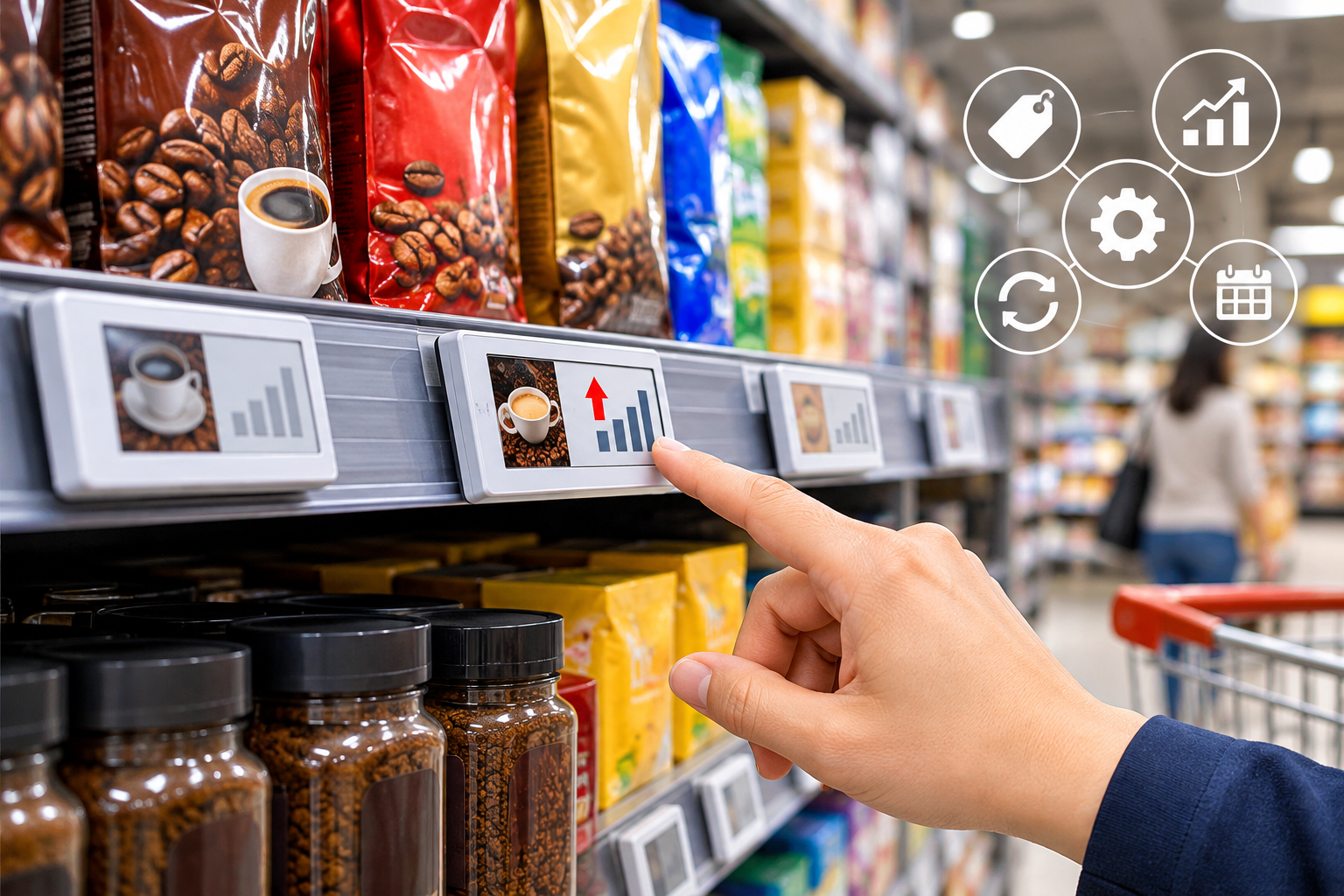

Managing product prices is an important responsibility for retail businesses. Supermarkets, pharmacies, electronics stores, and other retailers frequently update prices to reflect promotions, seasonal offers, supplier changes, and market conditions. Using traditional paper price tags for every update can take considerable time and may create inconsistencies between shelf prices and checkout systems.
Electronic Shelf Labels (ESLs) offer a digital approach to retail price management. Businesses researching electronic shelf labels price kuwait are increasingly interested in how this technology can simplify price updates, improve accuracy, and support efficient store operations.
Pointus Solutions understands the importance of modern retail technology in helping businesses improve daily processes. This article explains how electronic shelf labels can transform retail price management.
Table of Contents
-
What Are Electronic Shelf Labels?
-
How Do Electronic Shelf Labels Work?
-
Centralized Price Management
-
Improve Pricing Accuracy
-
Make Promotional Updates Easier
-
Reduce Manual Work and Operating Costs
-
Factors to Consider Before Investing
-
Frequently Asked Questions
-
Conclusion and Call to Action
1. What Are Electronic Shelf Labels?
Electronic Shelf Labels are small digital displays attached to retail shelves. They replace traditional printed price tags and show product prices and other relevant information.
Most ESL systems use electronic paper displays, which provide clear visibility and consume relatively little power when information remains unchanged.
Depending on the model, an electronic shelf label can display:
-
Product names and prices
-
Promotional offers and discounts
-
Product codes and barcodes
-
Unit pricing
-
QR codes and additional product details
These labels are commonly used in supermarkets, convenience stores, pharmacies, and large retail environments.
2. How Do Electronic Shelf Labels Work?
Electronic shelf labels operate through wireless communication between digital displays and a central management platform.
The process generally involves four steps:
Step 1: Update Product Information
A store employee changes a product's price or information through compatible retail management software.
Step 2: Send the Update
The central system communicates the updated information to wireless gateways or access points installed throughout the store.
Step 3: Receive the Information
The assigned electronic shelf label receives the update through its wireless connection.
Step 4: Display the New Price
The label refreshes its screen to show the updated price or product information.
This process allows retailers to manage multiple shelf labels without manually printing and replacing paper tags.
3. Centralized Price Management
One of the biggest advantages of electronic shelf labels is centralized price control.
Retailers can manage product prices through a central software platform rather than updating individual shelf tags manually. This is particularly useful for businesses with hundreds or thousands of products.
For example, when a supermarket changes the price of several products, employees can send updates through the management system. The relevant labels receive the information according to the system's configuration.
Centralized management can make price changes more organized and reduce the time required for routine updates.
4. Improve Pricing Accuracy
Price differences between shelves and checkout systems can create customer complaints and additional work for employees.
Electronic shelf labels can help reduce these inconsistencies when integrated with compatible POS or inventory management software.
For example, when a retailer updates product pricing in its connected system, the corresponding shelf label can receive the same information. This helps maintain consistency between displayed prices and business records.
However, retailers should configure integrations correctly and regularly monitor update status to ensure that information remains accurate.
5. Make Promotional Updates Easier
Retail businesses frequently introduce discounts, seasonal offers, and limited-time promotions. Updating paper labels for every promotional campaign can be time-consuming.
ESLs make promotional price management easier by allowing businesses to update supported display information digitally.
Retailers can use them to communicate:
-
Discounted prices
-
Promotional campaigns
-
Special offers
-
Seasonal pricing
-
Updated product information
This can help stores manage promotions more efficiently and keep shelf information aligned with their pricing plans.
6. Reduce Manual Work and Operating Costs
Replacing paper price tags requires printing, sorting, distributing, and attaching labels. These activities can consume employee time, especially in stores with frequent price changes.
Electronic shelf labels reduce the need for repeated manual replacement. Employees can spend more time assisting customers, organizing products, and managing inventory.
They can also reduce paper and printing requirements. However, retailers should consider the initial investment, battery replacement, infrastructure, software, and maintenance costs when evaluating long-term savings.
7. Factors to Consider Before Investing
Before purchasing an ESL solution, retailers should evaluate several important factors.
Display Size and Visibility: Choose display sizes that make product prices easy to read.
Wireless Coverage: Ensure that the store has suitable gateway placement and network coverage.
Battery Life: Compare expected battery life and replacement requirements.
Software Compatibility: Check whether the ESL platform integrates with existing POS, ERP, or inventory systems.
Installation Requirements: Consider shelf layouts, label quantities, mounting accessories, and installation costs.
Total Investment: When comparing electronic shelf labels price kuwait, evaluate display costs, gateways, software, integration, installation, and ongoing maintenance.
Retailers may also research self service kiosk machine price kuwait when planning broader technology upgrades. However, kiosks and electronic shelf labels serve different purposes: kiosks support customer interaction and self-service, while ESLs simplify shelf-level price and product information management.
Frequently Asked Questions
1. Can electronic shelf labels update prices automatically?
They can receive updated pricing information through a connected management system. The process depends on software integration, wireless communication, and system configuration.
2. Do electronic shelf labels reduce pricing errors?
They can help reduce errors by keeping shelf information aligned with connected pricing systems, provided updates and integrations work correctly.
3. Are electronic shelf labels suitable for supermarkets?
Yes. They are particularly useful in supermarkets with large product selections and frequent price changes.
4. Do electronic shelf labels require batteries?
Most electronic shelf labels use batteries. Their lifespan depends on the model, display technology, update frequency, and operating conditions.
5. What affects electronic shelf labels price in Kuwait?
Pricing depends on display size, technology, communication features, battery life, software, gateways, installation, and technical support.
Conclusion: Improve Retail Price Management with ESL Technology
Electronic shelf labels help retailers manage product prices through centralized software and wireless digital displays. They can simplify price updates, improve pricing consistency, support promotional campaigns, and reduce repetitive manual work.
Before investing, businesses should evaluate system compatibility, display features, wireless coverage, installation requirements, and long-term costs. Pointus Solutions encourages retailers to explore suitable technology solutions that support efficient and modern business operations.
Call to Action
Want to improve your retail price management with modern technology? Visit Pointus Solutions to explore business technology solutions and discuss options that match your retail requirements.


